
Overview
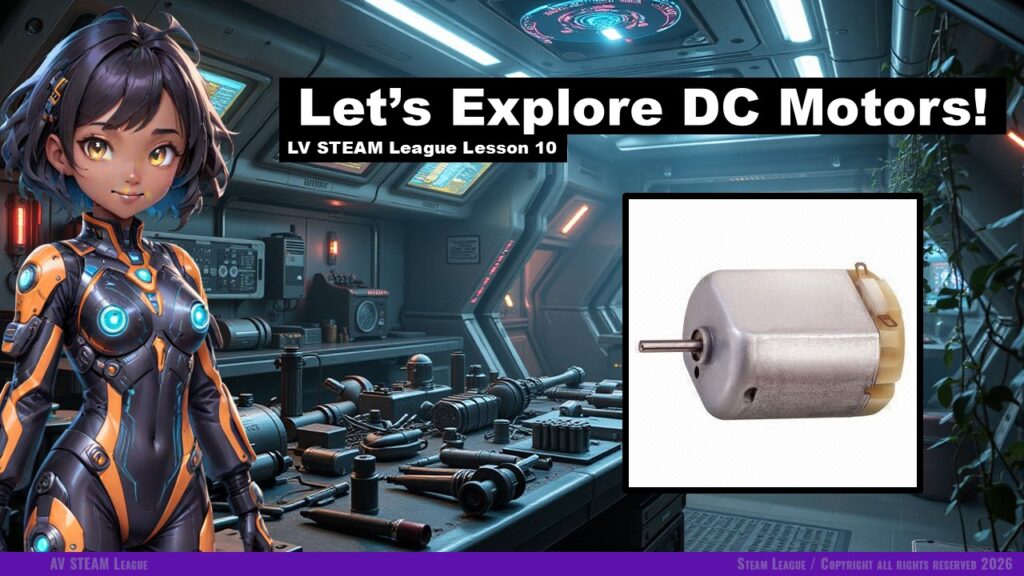
In this lesson students explore how different types of motors behave when powered by simple DC circuits. The goal is to help students build comfort with motors by giving them safe, hands-on time to experiment. They learn the difference between AC and DC electricity, discover how polarity affects motor direction, and observe how a DC motor responds when connected to a battery box. This lesson is intentionally simple, playful, and exploratory. It gives students a chance to relax into using motors before we move into more advanced motor control in later lessons.
Student Learning Goals
By the end of this lesson students will be able to: • Explain the difference between AC (alternating current) and DC (direct current) in simple terms
• Identify a DC motor and describe how it spins
• Connect a DC motor safely to a battery box using alligator clips
• Observe how switching polarity changes motor direction
• Record their observations in their journals
• Build confidence with motors as everyday STEAM tools
Materials Needed
DC motors (one per student or pair)
AA battery boxes with batteries installed
Alligator clip wires
Safety glasses
Journals and pencils
Teacher Preparation Notes
Test each motor ahead of time to make sure it spins reliably when connected to the battery box. Prepare a simple demonstration showing forward and reverse spin by swapping polarity. Make sure alligator clips are snug and safe. Set expectations that this lesson is about exploring, observing, and becoming comfortable with motors.
Safety Notes
We keep alligator clips away from skin and hair.
We never let motors spin near faces or loose clothing.
We disconnect the battery box before changing wires.
There is virtually zero electrical shock risk when using one AA battery box and a DC motor.
We work calmly and share materials respectfully.
Warm Up Activity
Ask students: What do you think happens when you give electricity to a motor? Let a few students guess. Keep the tone fun and curious.
Lesson Flow
Step One: AC vs. DC (Simple Overview)
Show the slides introducing AC and DC. Explain gently: • AC changes direction again and again. This is what powers homes. • DC flows in one steady direction. This is what batteries make.
Tell students that today we’re using DC because it is simple, safe, and perfect for motors.
Step Two: What Is a DC Motor?
Hold up a small DC motor. Explain: This motor spins when electricity flows through it. If we reverse the positive and negative wires, it spins the other way.
Let students feel the motor’s weight and examine the shaft (not spinning yet).
Step Three: Connect the Motor
Demonstrate: • Red clip to the positive side of the battery box • Black clip to the negative side • Other ends connected to the two terminals of the motor
Have students make the same setup.
Teacher note: Move around the room slowly, reassuring students as needed.
Step Four: Observe the Spin
Once connected, the motor will begin to spin. Ask students: What do you notice? Is it fast? Smooth? Strong?
Let them write a quick note or draw the spinning shaft in their journals.
Step Five: Reverse the Polarity
Have students switch the clips on the motor terminals. Ask: What changed? Most will notice the motor spins in the opposite direction.
Explain that this is the same idea used in robotics when we want wheels to turn forward or backward.
Step Six: Exploration Time
Let students experiment safely for a few minutes: • Try holding the motor gently (not near the spinning shaft).
• Try attaching a small paper flag to the shaft to make motion visible.
• Listen for changes in sound when switching polarity.
Journal prompt: What did you learn about making a motor spin?
Step Seven: Group Discussion
Ask: How could we use a motor like this in a robot or machine? Collect student ideas without correcting them — encourage imagination.
Teacher Notes for Each Slide Slide 1 Title: Set a playful, low-stress tone.
Slide 2 AC vs DC: Keep extremely simple. Focus on DC.
Slides 3–5 DC concept: Explain polarity gently.
Slide 6–end Motor and battery box: Demonstrate, then let students explore.
Independent or Group Activity
Students create a simple drawing showing: • The battery box
• The alligator clip connections
• The motor shaft
• Arrows showing forward and reverse rotation
Vocabulary and Concepts Direct Current (DC): Electricity that flows in one direction
Alternating Current (AC): Electricity that changes direction repeatedly
Polarity: Positive and negative sides of a DC circuit
DC Motor: A motor that spins when electricity flows through it
Wrap Up
Ask students: What was the most interesting thing you noticed about your motor? Would you like to try using motors in a project later?
Exit Ticket
Write one way to make a motor spin the other direction.
Or draw a motor with its positive and negative wires.
Quiz
- What type of current do batteries produce?
- What happens when you reverse polarity on a DC motor?
- What tool did we use to connect the motor to the battery box?
- What is one safety rule for working with spinning motors?
- Why is DC easy to use in our STEAM activities?
Teacher Reflection
Did students feel confident connecting the motor?
Was the pace comfortable?
Would adding a small propeller or wheel help students visualize the spin next time?