
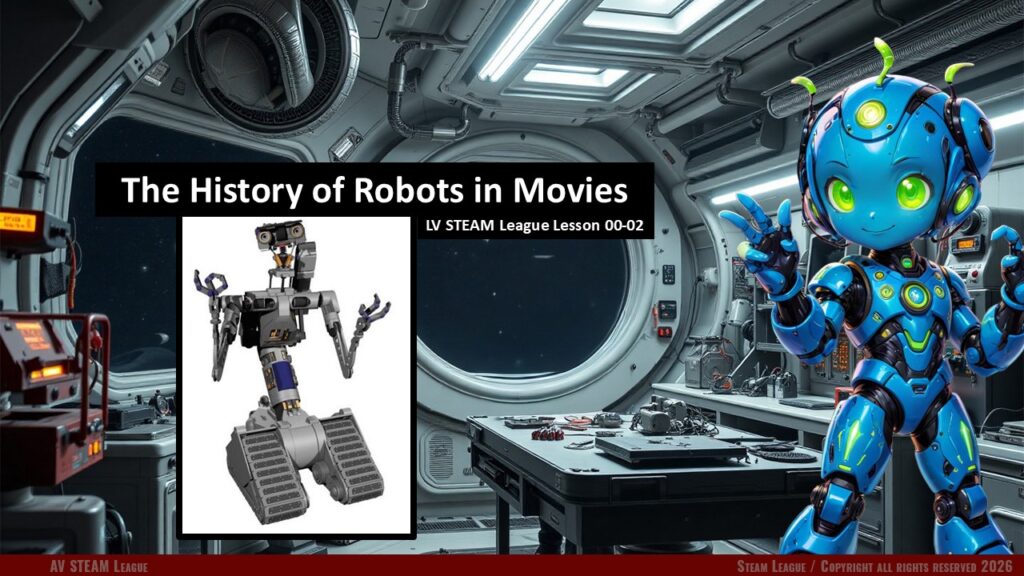
This lesson gives students a fun doorway into robotics by exploring how robots have appeared in movies over the last seventy years. Students discover how filmmakers imagine robots, what those designs say about human hopes and fears, and how movie robots sometimes inspire real engineering. They learn that creative storytelling and technology often grow together. This lesson helps students connect robots to culture, imagination, and the future they might help build.
Student Learning Goals
By the end of this lesson students will be able to
• Recognize well known movie robots and what makes each one memorable
• Describe how fictional robots reflect the technology of their time
• Compare movie robot abilities with real world robotics
• Identify which parts of a robot design are realistic and which are fantasy
• Practice creative problem solving by redesigning fictional robots so they could exist in real life
Materials Needed
Electronic journals
Optional robot toys or props that help spark imagination
Printed activity instructions if desired
Teacher Preparation Notes
Take a moment to look through the slide deck and notice the flow from older movies to newer ones. You do not need deep movie knowledge. Students often know some of these robots already, and the ones they do not know can still spark curiosity.
This lesson works well as a lively conversation. Students love talking about movies, characters, and designs. Your job is to gently guide the excitement back toward the big idea: movie robots are imaginative, but engineers can learn from them.
Have paper and pencils ready for the design challenge at the end.
Safety Notes
We care for our materials and our space.
We move calmly even when we are excited about robots.
If you show any physical robot props, students only handle them with permission.
We keep the classroom safe and respectful for everyone.
Warm Up Activity (Three minutes)
Ask students
What is the first robot from a movie or TV show that you remember
Let them share freely. Celebrate every answer, even silly ones.
Then ask
Do you think movie robots can teach us anything about real robotics
This sets the stage for the lesson.
Lesson Flow
Step One: Exploring Movie Robots Through Time
Walk students through the slides. Keep things playful and story driven.
For each robot, highlight three things
• What the robot looks like
• What role it plays in the story
• What the filmmakers imagined it could do
Examples you can use from the PPT:
• Gort is silent and powerful, like a walking warning.
• Robby the Robot is polite and helpful with a strong mechanical design.
• The Robot from Lost in Space protects its family with personality and expression.
• R2-D2 and C-3PO show two sides of robotic support, one technical and one social.
• Terminator and ED-209 reflect fears about machines becoming dangerous.
• WALL-E and Baymax show robots built for caretaking, comfort, and help.
Teacher note
Pause sometimes and ask
Why do you think the designers chose that shape or movement
What does this robot make you feel
This keeps students thinking like young designers.
Step Two: Real vs Fictional Robotics
Guide students into noticing which parts of these robots could exist today.
You can ask
Could a robot really scan like The Sentinels
Could a robot be soft and inflatable like Baymax
Could a machine repair a starship like R2-D2
Make sure students understand that imagination often leads engineering.
Engineers watch these movies and think
Maybe we could build something like that someday.
Teacher note
Reassure students that there are no wrong answers here. This is about curiosity and connections.
Step Three: Activity — “Fix the Fiction” Robot Design Challenge
This activity comes directly from the PPT.
Students choose a movie robot they like and redesign it so it could work in real life.
Tell students
Choose your favorite movie or TV robot.
List the parts that are clearly fictional.
Rewrite or redesign those parts so they could work in the real world.
Draw a realistic version of your robot.
Encourage students to think gently and creatively.
Maybe they adjust the power source.
Maybe they simplify the movement.
Maybe they replace a magical sensor with a real one like sonar or a camera.
Teacher note
Some students may struggle with drawing. Remind them that simple shapes are perfect. The idea is what matters.
Give students ten to fifteen minutes for this part depending on the group.
Step Four: Sharing and Reflection
Invite students to share their redesigned robots.
Ask guiding questions
What did you change
How does your new version work
Why do you think this robot could exist in the real world
This step helps students understand that engineering begins with imagining something and then making it possible.
Teacher Notes for Each Slide
These notes follow the order of the PPT and offer simple talking points. All slide info originates from the PPT.
Gort
Emphasize size, power, and the theme of protection.
Robby the Robot
Talk about his friendly nature and early ideas of programmable service robots.
Lost in Space Robot
Highlight personality and the iconic phrase students might have heard.
R2-D2 and Astromechs
Mention problem solving and creative mechanical tools.
C-3PO
Focus on translation, etiquette, and human interaction.
Terminator Endoskeleton
Carefully discuss strength and durability without leaning into fear.
ED-209
Show how strict programming creates problems.
Johnny 5
Point out curiosity and self direction.
Sentinels
Describe swarm movement and scanning.
Iron Giant
A gentle giant with a heart.
Transformers (Optimus Prime, Megatron)
Transforming parts inspire creative engineering thinking.
WALL-E and EVE
Talk about environmental work and search technology.
Baymax
A soft robot designed for care.
K-2SO and Chappie
Show reprogramming and evolving personalities.
Jaegers
Human piloted robots that inspire exosuit and mech research.
Fix the Fiction Activity Slide
Read the instructions clearly and encourage creativity.
Independent or Group Activity
Students can pair up and compare their redesigned robots.
They ask each other
What did you change
Why does your design make more sense
Could your robot help people in real life
This helps deepen understanding through teamwork.
Vocabulary and Concepts
Fictional Something created by imagination rather than real technology
Realistic design A robot feature that could work using today’s engineering
Astromech A repair robot in the Star Wars universe
Endoskeleton A metal interior frame similar to a skeleton
Swarm A group of machines working together like insects
Reprogramming Changing how a robot thinks or behaves
Wrap Up
Ask
Which robot inspired you the most
Did you redesign anything in a surprising way
What did you learn about how movies imagine the future
Encourage students to notice how imagination and engineering connect.
Exit Ticket
One fast question
Name one movie robot and one part of it that could actually work in real life.
Quiz
Friendly and low stress.
1. Multiple Choice
Which robot is known for saying “Danger, Will Robinson”
A. R2-D2
B. Baymax
C. The Robot from Lost in Space
D. Megatron
2. Short Answer
Why is WALL-E important in his movie
3. Multiple Choice
Which robot is soft and inflatable
A. ED 209
B. Baymax
C. Gort
D. Robby the Robot
4. Short Answer
What is one difference between a fictional robot and a realistic robot
5. Reflection
Which movie robot would you redesign and why
Teacher Reflection
What moments sparked the most excitement
Did students understand the difference between fiction and real robotics
Which parts of the discussion should be expanded next time
Were students engaged during the redesign activity