
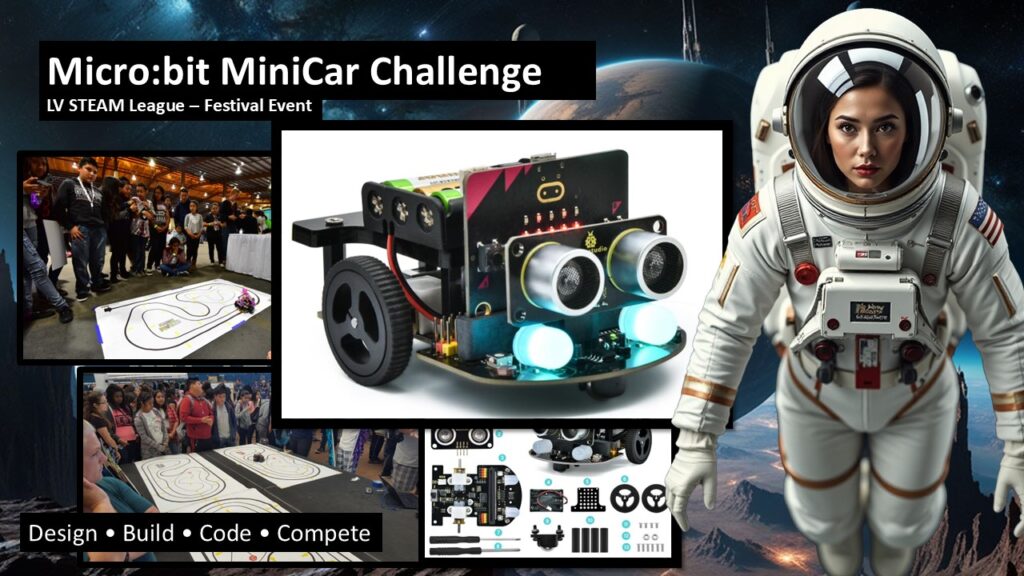
In this lesson, students prepare for and understand the micro:bit MiniCar Challenge. This lesson frames the challenge as a celebration of creativity, teamwork, problem solving, and persistence rather than just a competition. Students learn the structure of the event, how scoring works, and what is expected of them as a team.
The focus of this lesson is helping students feel excited, prepared, and confident. Students see that the challenge is not about perfection but about testing ideas, learning from results, and improving through iteration.
Student Learning Goals
By the end of this lesson students will be able to: • Explain what the MiniCar Challenge is • Understand the rules and flow of the event • Describe how scoring works • Identify their role within a team • Prepare their robot and code for a challenge environment
Materials Needed
Completed Mini Robot Car builds micro:bit boards with code loaded Printed or projected challenge track image Stopwatch or timer Open floor space for practice runs
Teacher Preparation Notes
Before class, review the challenge rules and scoring so they can be explained calmly and clearly. If possible, mark a practice track area or show an image of the official track so students can visualize the challenge. Be ready to reinforce teamwork, safety, and sportsmanship.
Safety Notes
We move robots only on the track area We keep hands off robots during runs We watch our surroundings We support each other respectfully We celebrate effort and learning
Warm Up Activity
Ask students: What does it mean to test something instead of just build it
Explain that today they will learn how builders and engineers prepare for real challenges.
Lesson Flow
Step One – What Is the MiniCar Challenge
Explain that the micro:bit MiniCar Challenge is a full STEAM journey where teams design, build, code, test, and compete with their robot. Emphasize that beginners are welcome and that learning happens through trying, adjusting, and trying again.
Explain that this challenge is part of a festival-style event where many teams come together to share their creations.
Step Two – Who the Challenge Is For
Explain the age groups and categories in a simple way. Let students know they will compete against teams close to their age so the experience feels fair and encouraging.
Explain that teams work best when everyone contributes and supports each other.
Step Three – Team Structure
Explain that teams usually have three to five members and a mentor. Talk about how different roles can exist on a team, such as coder, builder, tester, or note-taker, and that roles can change as the team learns.
Step Four – The Robot and the Track
Explain that each team uses a micro:bit and a Mini Robot Car. Describe the track as a printed line path that twists and changes as it goes.
Explain that the robot’s goal is to travel as far as it can along the track without human help once the run begins.
Step Five – How the Event Works
Explain the event day flow step by step: Teams arrive with robots and code ready Each team gets three runs Each run has a time limit Once a run starts, the robot cannot be touched
Explain that this helps make the challenge fair and exciting.
Step Six – Scoring
Explain that scoring is based on the farthest distance the robot reaches on the track. Yellow markers show distance points. The highest distance reached across all runs is the team’s score.
Emphasize that consistency and smart improvements matter.
Step Seven – Preparing for the Challenge
Talk about the importance of testing code, making small changes, and observing how the robot behaves. Encourage students to practice patience and teamwork.
Remind students that challenges help them grow as builders.
Teacher Notes for Each Slide
Use the slides to reinforce excitement and clarity. Pause often for questions. Keep the focus on learning, teamwork, and confidence rather than winning.
Independent or Group Activity
Have teams review their robot and code together. Ask them to discuss one improvement they want to test before the challenge.
Vocabulary and Concepts
Challenge A task that tests skills and creativity
Iteration Making changes based on results
Run One attempt on the track
Score A way to measure progress
Wrap Up
Ask students: What part of the challenge excites you most What will your team focus on improving How can you support your teammates during the event
Reinforce that effort, curiosity, and teamwork matter most.
Exit Ticket
Answer one question: What is one rule of the MiniCar Challenge
Quiz
- What is the goal of the MiniCar Challenge
- How many runs does each team get
- When are you allowed to touch the robot
- How is the score calculated
- Why is teamwork important during the challenge
Teacher Reflection
How prepared did students feel Did teams understand the rules clearly What excitement or concerns came up