
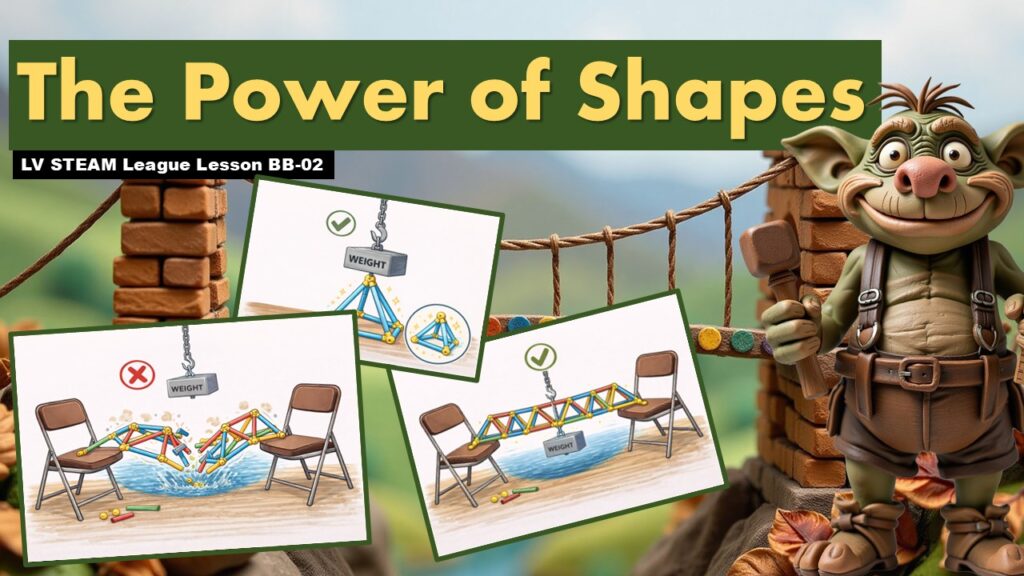
This lesson teaches students that strength comes from shape, not material. Students learn why some shapes bend while others stay rigid, and why triangles dominate real bridge design. The lesson prepares students to make intentional design decisions during the bridge challenge instead of guessing.
This is the conceptual backbone of the entire Bridge Builders program.
Recommended Age Range
Upper elementary through middle school
Scales naturally by depth of discussion
Time Required
Total time: 30–40 minutes
- Concept discussion: 20–25 minutes
- Physical demonstrations or gestures: 10 minutes
- Wrap-up and transition: 5 minutes
Materials Needed
- Lesson BB-02 slide deck
- Optional demo materials:
- Drinking straws
- Connectors
- Hands for pushing shapes (no tools required)
No full building yet.
Learning Objectives
By the end of this lesson, students should be able to:
- Explain why shape matters more than material
- Describe why squares bend and triangles resist movement
- Understand load sharing in simple terms
- Predict which designs will fail before building
Lesson Flow
Slide Section 1
Shapes Matter More Than Materials
Facilitator Focus
This is the anchor concept. Say it clearly and confidently.
Key idea:
Engineering is about using smart shapes to help weak materials work together.
Emphasize:
- Straws are weak by themselves
- Engineering does not make materials stronger
- It makes them work together better
Avoid mentioning weight limits yet. Keep it conceptual.
Slide Section 2
What Happens When We Build With Straight Lines
Facilitator Focus
This is where students feel the problem.
Explain:
- Squares and rectangles change shape
- The straws stay the same length
- The angles move
Optional physical demo:
- Make a square with hands or straws
- Push gently
- Let students see the shape deform
Key phrase:
If the shape can move, the load is not controlled.
Slide Section 3
Why Triangles Are Different
Critical Concept Slide
Explain:
- A triangle cannot change shape without breaking something
- Movement is locked
- Force must travel through the structure
Contrast clearly with the square:
- Square bends first
- Triangle breaks first
That difference matters.
Slide Section 4
Triangles Lock a Structure in Place
Facilitator Focus
This slide is about shared responsibility.
Explain:
- Each straw supports the others
- No single straw carries everything
- The shape holds itself
Say explicitly:
This is why engineers trust triangles.
This connects directly to real bridges and towers.
Slide Section 5
Straw Bridges Work Best When Built From Triangles
Facilitator Focus
Now bring it back to the materials students will use.
Explain:
- Straws bend easily
- Triangles reduce bending
- Load is shared across many pieces
Key idea:
Many small jobs are better than one big job.
This prepares them for trusses without naming them yet.
Slide Section 6
Connectors Make Triangles Possible
Important Practical Insight
Explain:
- Connectors control angles
- Angles are what make triangles work
- Sloppy connections weaken strong shapes
This helps students respect connectors as structural parts, not just joints.
Slide Section 7
Engineering Rule to Remember
Memorization Moment
This rule is correct and defensible.
Reinforce:
- Weak does not mean broken
- Weak means uncontrolled
- Strong means predictable
Say:
Engineers hate surprises.
That line sticks.
Slide Section 8
Why Bending Is a Problem
Address the Smart Kid Objection
This slide answers:
“If it didn’t break, why is it weak?”
Explain:
- Bending moves the load
- Load concentrates
- Each test makes it worse
Key sentence to emphasize:
A bridge’s job is to hold weight and stay the same shape.
That sentence carries the whole program.
Final Slide
Are You Ready to Build
Transition Moment
Do not rush this.
Say something like:
Now you know what strong designs look like.
Next, you’ll be asked to prove it.
This cleanly hands off to the challenge.
Assessment (Informal)
Listen for students saying things like:
- “That will bend”
- “That triangle will hold better”
- “The load is shared”
If they can predict outcomes, the lesson worked.
Facilitator Notes
- Do not introduce competition yet
- Do not allow building during this lesson
- Let students argue and reason
- Let them be wrong safely
This lesson exists so the challenge feels fair, not random.
Transition to BB-00: The Bridge Challenge
Close with:
Tomorrow, you won’t be told how to build.
You’ll be tested on what you understand.That frames the challenge as thinking, not crafting.