
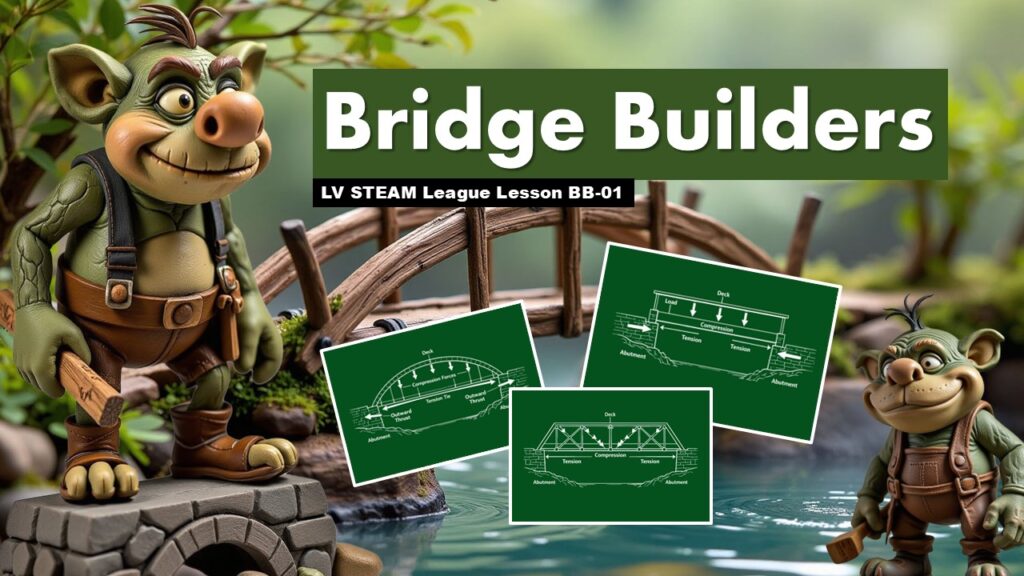
This lesson introduces students to bridges as engineering solutions, not objects. Students learn why bridges exist, how long humans have been building them, and how engineers classify bridges by how they carry load. The goal is understanding structural families, not memorization.
This lesson sets the conceptual foundation for later design and building.
Recommended Age Range
Upper elementary through middle school
Scales well with discussion depth
Time Required
Total time: 30–40 minutes
- Introduction and discussion: 10 minutes
- Bridge types overview: 20–25 minutes
- Wrap-up and curiosity hook: 5 minutes
Materials Needed
- Lesson BB-01 slide deck
- Optional physical demo materials (not required):
two books, a ruler or stick, string
No building occurs in this lesson.
Learning Objectives
By the end of this lesson, students should be able to:
- Explain why bridges exist
- Understand that bridges solve different problems
- Identify major bridge families by structure
- Recognize that different designs carry force in different ways
Lesson Flow
Slide Section 1
Why Do Bridges Exist
Facilitator Focus
Emphasize that bridges exist because the world gets in the way.
Do not overcomplicate this section.
Key ideas to reinforce:
- Obstacles force design decisions
- Bridges connect people and places
- Engineering exists to solve problems
Ask students:
- What kinds of things stop us from going straight
- Why not just walk around
Let students answer freely.
Slide Section 2
How Old Are Bridges
Facilitator Focus
This is about human problem solving over time, not history trivia.
Reinforce:
- Early materials were weak
- Engineers learned by trial and failure
- Designs evolved as materials improved
You can ask:
- What would you use if you had no metal
- How would you cross a river with only wood or rope
Slide Section 3
Bridge Types Overview
Critical Teaching Moment
This is where confusion often starts, and you handle it correctly in the PPT.
Say clearly:
Engineers group bridges into families based on how they carry force.
Stress:
- No “best” bridge
- Only the right bridge for the problem
Bridge Families Section
For each bridge type, the goal is recognition and reasoning, not technical mastery.
Beam Bridge
Focus on:
- Simple support
- Short spans
- Compression on top, tension on bottom
Optional demo:
Balance a ruler between two books and press in the middle.
Arch Bridge
Focus on:
- Force moving sideways
- Compression through the arch
- Ground and abutments matter
Key phrase:
Arches push outward, not just downward.
Truss Bridge
This is the most important bridge for your program.
Focus on:
- Triangles
- Shape resisting change
- Efficient use of material
Plant the seed:
This is the type you’ll be building later.
Cantilever Bridge
Focus on:
- Balance
- Building outward
- Counterweight thinking
Avoid construction details. Keep it conceptual.
Suspension Bridge
Focus on:
- Hanging
- Tension in cables
- Long spans
Key phrase:
Some bridges hang instead of stand.
Cable-Stayed Bridge
Focus on:
- Direct load paths
- Stiffer than suspension
- Fewer cables, more control
Do not compare costs. Keep it visual and structural.
Tied-Arch Bridge
Focus on:
- Combining ideas
- Controlling outward force
- Hybrid thinking
This reinforces that engineering ideas evolve.
Naming Confusion Slide
This slide is excellent and should be emphasized.
Reinforce:
- Many names describe variations
- Core ideas repeat
- Engineers care about behavior, not labels
This protects students from internet confusion later.
Closing Slide
Trolls Under the Bridge
This is not fluff. It’s a reset.
Purpose:
- Light humor
- Ends lesson on curiosity
- Makes bridges feel human and cultural
Let it land. Do not explain it.
Assessment (Informal)
You do not need a quiz.
Listen for students saying:
- “That bridge pushes sideways”
- “That one hangs”
- “That one uses triangles”
If they can describe how a bridge works in plain language, the lesson succeeded.
Transition to Next Lesson
Close with something like:
Now that we know different bridges exist, next we’re going to learn what makes some shapes stronger than others.
This cleanly sets up BB-02: The Power of Shapes.
Facilitator Note
Do not rush this lesson.
Understanding structure before building is what makes your program different from a craft activity.