
Overview
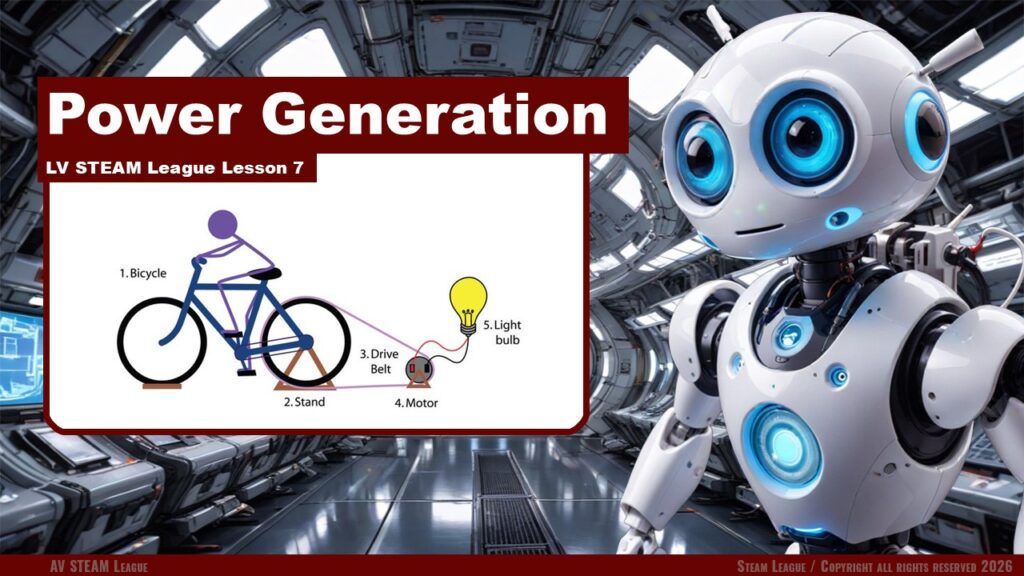
This lesson introduces students to the incredible idea that electricity can be created through movement. Students learn about Michael Faraday’s discovery that moving magnets near a coil of wire produces electrical current, and they explore the main parts of a generator in simple, friendly language. They then look at how real power plants use mechanical force to turn generators, discovering that all electricity we use must be mined, harnessed, or collected from the world around us. New slides introduce the idea that making is more than building parts. It is invention, innovation, and teamwork. The lesson ends with a collaborative design challenge where teams brainstorm and present their own creative method for turning a generator.
Student Learning Goals
By the end of this lesson students will be able to:
• Explain Faraday’s discovery in simple terms
• Identify the main parts of a generator
• Recognize that all power generation begins with mechanical or chemical energy
• Compare different power generation methods used in the United States
• Work in teams to design a creative way to turn a generator
• Communicate and present their team’s idea with confidence
Materials Needed
Projector or printed slides
Chart paper or whiteboard
Markers for team brainstorming
Journals and pencils
Teacher Preparation Notes
Preview the videos ahead of time and decide which ones best fit your schedule. Be ready to guide the discussion gently, keeping the focus on curiosity and understanding. Prepare a clear explanation of Faraday’s discovery using simple language. Plan space for team collaboration.
Safety Notes
We handle all magnets and demonstration tools carefully.
We keep fingers away from any spinning items.
We work in teams respectfully and keep materials on tables.
Warm Up Activity
Ask students:
Where does the electricity in your house actually come from
Let students share freely. Build excitement by telling them today they will learn how electricity is physically made.
Lesson Flow
Step One: Faraday’s Discovery
Introduce the story of Michael Faraday. Use the slides to show how moving magnets inside a coil of wire makes electrons move. Keep it simple:
Movement creates electricity.
Ask students to sketch in their journals what they think is happening inside the coil.
Step Two: Main Parts of a Generator
Walk students through the generator slides:
• Magnets
• Coil of wire
• Commutator (keeps electricity connected as the coil spins)
Show how each part works together. Focus on the idea that spinning is the key.
Step Three: How We Turn Generators in the Real World
Explain that every generator must be turned by some kind of force. Show the slides about U.S. energy sources and briefly describe each one: coal, natural gas, wind, nuclear, hydro, solar, geothermal.
Teacher note: Keep the tone warm, simple, and visual.
Step Four: Video Exploration
Show one or two of the short videos from the slides. Pause to highlight where a turbine or shaft is turning a generator.
Ask:
Which part of the video showed the generator being turned
Step Five: Power Must Be Harnessed, Mined, or Collected
Use the slides to reinforce that electricity does not appear by magic. It always begins with mechanical or chemical energy.
Journal prompt:
Where else in life do you see movement being turned into power
Step Six: Introduction to Innovation and Teamwork
Explain the new slides: being a maker is not just building parts—it is invention. Innovation is taking what you have and improving it. Teamwork helps ideas grow stronger.
Tell students they will use teamwork to design a new way to turn a generator.
Step Seven: Team Innovation Challenge
Give students 20 minutes to brainstorm in teams. Each team:
• Draws a diagram of their idea
• Labels how the motion will turn the generator
• Selects one spokesperson to present
Encourage playful creativity: pedals, gears, pulleys, falling objects, spinning art, wind, water, or anything else that moves.
Tell students:
Your job is to imagine how to turn a generator using any safe, real world source of motion.
Step Eight: Presentations
Each team presents their design in under one minute. Celebrate all ideas.
Teacher Notes for Each Slide
Slide 1 Title: Introduce the excitement of making electricity.
Slides 2 to 6 Faraday: Go slowly and clearly.
Slides 7 to 12 Generator parts: Show how spinning matters.
Slides 13 to 17 Real energy sources: Keep simple, focus on movement.
Slides 18 to 22 Videos: Pause to explain.
Slides 23 to 25 Innovation: Emphasize creativity and teamwork.
Slides 26 to end Team challenge: Give clear timing and expectations.
Independent or Group Activity
Teams design a detailed generator turning method using only recycled materials. They sketch a full diagram and write a short explanation.
Vocabulary and Concepts
Generator A device that turns movement into electricity
Turbine A spinning device that turns a generator
Commutator A connector that keeps wires in contact as the coil spins
Mechanical force Movement that can be turned into energy
Innovation Improving something in a creative way
Wrap Up
Ask students:
Which part of today’s lesson helped you understand generators the most
What teamwork strategy helped your group the most
Let students share.
Exit Ticket
Draw one source of motion that could turn a generator.
Or write one sentence explaining Faraday’s idea.
Quiz
- What makes electricity in a generator
- Name two parts of a generator
- Why does every generator need movement
- What is innovation
- Why is teamwork helpful in designing solutions
Teacher Reflection
How well did students understand the idea of mechanical motion creating electricity
Did teamwork improve creativity
Would you adjust timing for the design challenge next time